How are you feeling today? Maybe you feel like I do: Anxious, fraught with unease and uncertainty. It’s a feeling we normally seek to escape, right? Today I’m asking you to lean into your uncertainty and use it in your writing.
“Have patience with everything that remains unsolved in your heart…live in the question.” ~Rainer Maria Rilke – Letters to a Young Poet
Your prompt then is this:
Maybe have a bit of fun with the rarely used omniscient POV. Adopt an odd all-seeing voice perhaps. Then give us a character who is mired in uncertainty. Shit’s about to go down, either dramatically or more subtly. The uncertainty will be deeply uncomfortable for your character, but deliciously compelling for your reader. Your first line should go something like this:
“[Character name] doesn’t know [about the thing that’s about to happen to the world or to herself]…”
Take it from there. Go where the writing takes you. Set off without a map or compass or plan. Lean into uncertainty in today’s practice..
Choreographer Twyla Tharp in her book, The Creative Habit, encourages creatives to keep a journal of the things we see (hear, taste, smell, etc.), especially when they are juxtaposed in interesting ways that draw our attention, be they intentional or accidental.
It’s tremendously useful to keep a journal of the things that particularly draw your attention in your daily life. Maybe the idea of writing lots and lots of pages of your inner workings every day doesn’t appeal. But you can jot things down. And when you’re stuck, go back and look at them again. I have these odd notes on my phone: snippets of overheard conversation, a phrase from a song, peculiarities of the natural world (or of my neighbors down the street). Lots and lots of photos. Collect images and ideas you’re attracted to. Put them in your phone or folder or spiral notebook, whatever. Just don’t rely on memory!
Doing this, coupled with some daily “down time” (even if only for 15 minutes) will work magic on your creativity.
It’s about openness and receptivity to, well, a sort of creative alchemy.
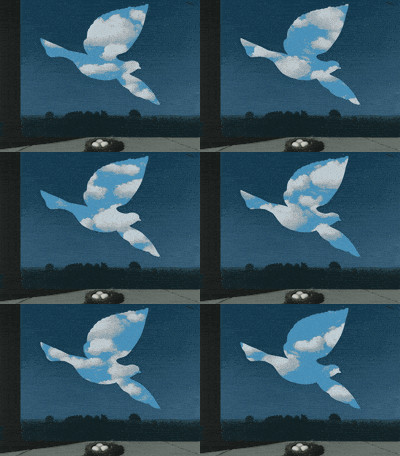
Via: Giphy Flying Rene Magritte GIF by Feliks Tomasz Konczakowski
Juxtaposition is defined as: “the act or an instance of placing two or more things side by side often to compare or contrast or to create an interesting effect.” (Merriam-Webster)
Poets are great at juxtaposition. Haiku writers and mosaicists specialize in it. They jam two or more very different ideas or images together to create new meaning and associations. It’s why we so often get an “ah ha!” experience from reading poetry. Filmmakers and photographers and visual artists of all stripes also make powerful use of juxtaposition.
But flash writers can (and should) make this a part of their toolbox as well.
In Joy Williams’ collection Ninety-Nine Stories of God, (a book I highly recommend), there’s a flash called “Veracity” that manages, in a scant couple of hundred words, a brilliant juxtaposition of church pews, a birthday bounce house, a dog, and a ’64 Airstream Globetrotter. And every single one of these elements feels necessary and significant.
My flash, “Foundling” (below) uses a similar jamming together of elements in a very short space:
Foundling
They discovered the baby in the grass, under the snapping cotton sheets. The clothesline spun and creaked, throwing light, then shadow, on his face, his wee head smooth and curved as a doorknob. The woman didn’t bend, only drew her hair from her eyes. He smells like Malt-o-Meal, the little girl said, hoisting him. Support his neck, the woman told her. It’ll snap like a pencil. Christmas Eve, her husband had packed and left for Cincinnati. Now, as raindrops dotted their arms, and the woman’s skirt flicked her calves, he came rushing through the gate, holding a newspaper over his head, calling Margaret! Margaret!
The exercise below will have you bumping together disparate objects / images / ideas in micro form to see where it takes you, what surprises you, what you unearth. You may discover new meaning is created when juxtaposing two disparate objects, ideas, or images. Forcing yourself to do this in a very small space actually serves to ramp up the power of juxtaposition. Very little room is left to “explain” yourself. You must allow what your unconscious delivers to you. The results are often delightful or disturbing, but always surprising.
Microfiction is variously defined by different word limits. For our purposes, let’s say 150 words or fewer. Microfiction often resembles prose poetry. The line between flash and prose poetry is wafer thin at times. But please set aside any need to categorize your work at this juncture. Allow whatever emerges.
So! Your prompt:
I want you to combine two or more disparate elements as compactly as you can, bump them up against each other, in as tiny a story as possible.
Don’t worry in this first draft about “making sense”…your unconscious has a tendency to make its own kind of beauty and sense. It’s what we are wired to do, after all. Find the patterns. And if we can’t find them, we create them.
Choose ONE from List A and ONE from List B and get to work!
Try to keep to just 150 words or fewer if you can.
List A
tangerine
ghost
disco ball
Isaac Newton
surgeon
List B
Saturn
Marilyn Monroe
fortune teller
continental drift
funnel cloud
This prompt will be easier if you allow whatever delightful or disturbing weirdness ensues and resist the urge to explain it. Enjoy!
Many thanks to the amazing Karen Stefano, author of The Secret Games of Words and a forthcoming memoir, Vigilance, for inviting Nancy and me to take part in her wonderful podcast series. Here, we talked about all things flash fiction, about our flash fiction retreats, and did a “mini workshop” of our own flash stories. Have a listen!
Sometimes our stories fall flat, without that “pop” of tension. One great way to create urgency in a flash fiction story is by using another constraint: Time.
For almost a decade now, all my college classes have begun with a 10-minute timed writing. Timed writing is nothing new. We know that it helps us transition us into the writing space, like stretching before a workout. We know that it forces us to stay present and dig deeper—writing past where we might have naturally given up. And we know that keeping the pen moving quickly, without crossing things out or rereading, is a great way to evade the internal critic and uncover fresh ideas.
But I discovered something else through years of this practice: 10 minutes of writing without stopping is also the perfect amount of time to draft a flash fiction story idea from start to finish.
It makes sense: Flash fiction is defined by a (word) constraint, so why not create under a time constraint? Having that clock ticking while you furiously try to reach the end of an idea gives the piece a natural sense of urgency. And writing from the beginning to the end in one sitting also creates a sense of continuity—we see the end coming as we embark on the journey.
I do most of my timed writings longhand, scribbling. But it works with typing as well. And you can use a timed writing in many ways. For instance, you can:
Set the timer while writing to a prompt.
Set the timer when you’re feeling stuck and don’t know what to write about.
Set the timer and rewrite a “flat” story from scratch while the clock chases you to the finish line (my favorite)
And as a daily practice it’s even better.
Besides, you can do anything for 10 mins, right?
Regardless of how you use it, a 10-minute burst of writing can break you through resistance and lethargy. And creating something to push against allows inspiration to bulge and balloon in interesting and unexpected ways.
~Nancy
(How did it work for you? Share in the comments below!)
Often if we’re stuck on a piece of writing it’s because we’re tamping down some essential voice that is screaming (or whispering urgently) to get out. It’s useful to just allow that character to talk. So today I’d like you to write a MONOLOGUE. You may quickly set the scene for this monologue, but I want the bulk of your flash to be one person talking to an audience of one or more. Approach this any way you like. Your character may be a space alien or an animal or a child or a potato chip. Just give them the floor, the microphone, the podium, the flashlight around the campfire.
Examples of monologues:
Your character wants to make a case for something.
Your character wants to rally the troops against an enemy.
Your character wants to profess her love (or her hate).
Your character wants to defend herself.
Your character has a bone to pick.
Your character goes on a rant.
Your character wants a job.
Your character is simply telling a fascinating story.
Does this monologue qualify as a story? Remember my three essentials to flash fiction: Emotion, Movement, and Resonance. How you get there doesn’t much matter as long as you demonstrate these three. Write quickly without judgment and you will soon have a fresh draft that may surprise you!
Aim for 500 words or fewer! Go!
For inspiration here’s a great one, Charlie Chaplin from The Great Dictator:



 Open Your Art Writing Retreats