Blog

Uncategorized

The Write Place to Be: Casperia in Italy’s Wars by Bryan Jansing

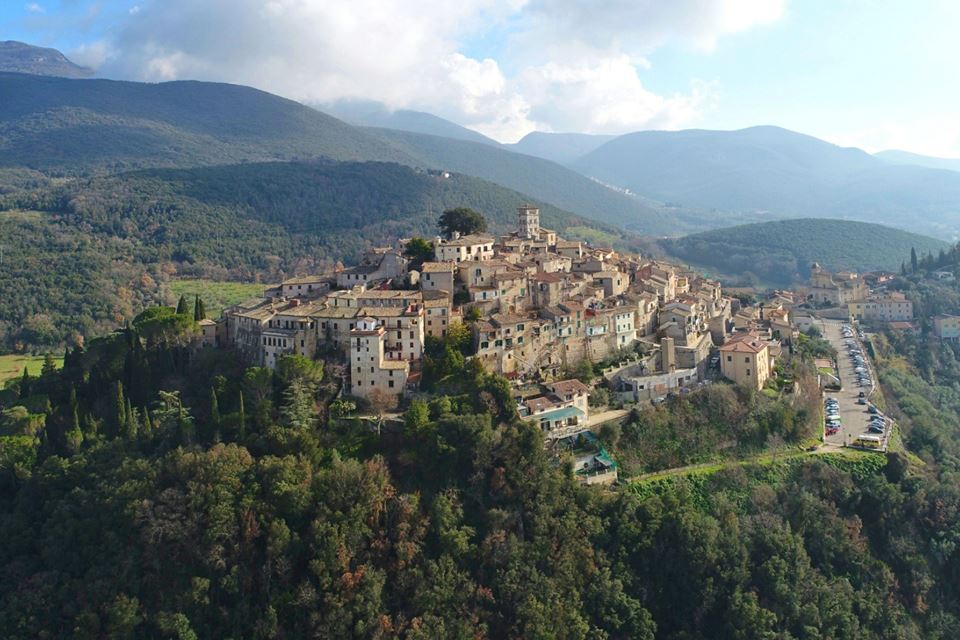
In anticipation of our Italian Flash Fiction retreat in May, we asked native Italian Bryan Jansing to talk a bit about how Casperia and the Sabina Hills feature in Italy’s long history.

Casperia in Italy’s Wars

by Bryan Jansing

The first stop after leaving Rome to reach Casperia is Poggio Mirteto train station. Standing before the hilly slopes and fast rising mountains as you leave the train into Poggio Mirteto is a large billboard dedicated to the partisan fighters of World War II. The 8th of September 1943 is an important date in Italian history; it’s the day Italy joins the allies. Poggio Mirteto, like many of the small towns and villages peppered throughout the ridges of the Apennine in the Lazio region, was nurturing grounds for the Italian resistance. As the armistice with the ally armies goes into effect, German soldiers flee Rome, passing through the hilly and stony slops of Sabina, Caspera and most importantly, through the train station of Poggio Mirteto. Over these tracks passed retreating Nazi soldiers, their equipment, prisoners and trains loaded with captured Jews headed to concentration camps.

Liberated from Mussolini, Italian soldiers and their generals, along with ally soldiers who escaped Nazi prison camps behind enemy lines, Jews who fled their captors and others on the run in these mountains unite to form the Italian resistance, the partisans.
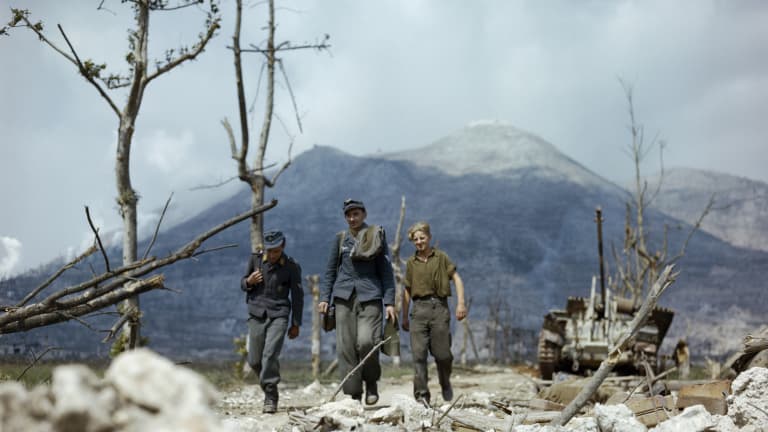
the-campaign-in-italy-the-advance-on-cassino-may-1944Until the end of World War II this ragtag army, whose ranks are filled with a hodgepodge of unlikely heroes unite to sabotage the retreat and occupation of the Nazis. The billboard at Poggio Mirteto reminds us of these heroes who rose during a terrifying and bloody period.

Battles in these hills go back to the Etruscans, the first inhabitants of this region. The Etruscans ruled from 900 BC until a small village called Rome would revolt in 483 BC. Then there were the attacks by barbarians as the Roman Empire disintegrated, the feuding wars of the Middle Ages and the renaissance. Little towns like Casperia were safe in their fortified villages way up on high peaks and allied to like-towns through fiefdoms. It’s not hard to let your imagination run and let the array of time pass through you.

Italy lagged behind as a third world country without trains or paved roads to connect these old, medieval towns left forgotten, until Mussolini brought Italy to the industrial revolution in the late 1930s. For this reason, Casperia remains nearly untouched. Its charm and tranquil setting allow us to slip back to a time where life moved slower, where there was time to think, relax and catch our breath and strengthen our relationship with our often neglected muse.
Bryan Jansing is an international, award-winning author. His Flash Fiction was included in Fast Forward Vol. 3, The Mix Tape (2010), which was the finalist for the Colorado Book Awards. He has also written for Beer Advocate, Celebrator, Primo and Ringling Bros. and Barnum & Bailey Circus. His book Italy: Beer Country is the first and only book available about the Italian craft beer movement. Find out more about Bryan here

Read Nancy Stohlman’s interview with Bryan here: 
bigbook

Tour Italy with the authors of
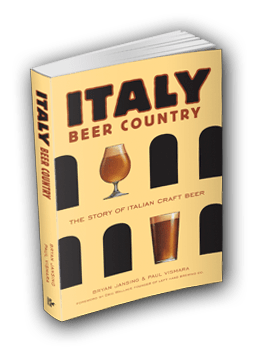
Italy: Beer Country The Story of Italian Craft Beer Book your tour: www.ItalyBeerTours.com

 
Facebook: @ItalyBeerTours
Instagram: @ItalyBeerTours
Twitter: @ItalyBeerTours
 
In bocca al luppolo!

UPDATE: Our Springtime in Italy Flash Fiction Retreat is SOLD OUT. We have openings in Grand Lake in August and exciting announcements coming soon!

Uncategorized

Writing Wild in Costa Rica retreat starts tomorrow!

We are Costa Rica bound! Looking forward to flash fiction camaraderie on the black sand beaches of Playa Negra. Pictures coming!

aec8c152-d80d-4e3c-bdf7-9facc0e2f6ef.hw1_

Want to know more or join us for a retreat in 2019?

Springtime in Italy (1 spot left)

Summer Camp in Grand Lake Colorado

Happy writing, everyone!

Love,

Nancy and Kathy

Uncategorized

“Time in Flash Fiction” by Sophie van Llewyn on TSS Publishing

A great craft article on using time in flash fiction with examples by Kathy Fish, Nancy Stohlman, AE Weisgerber, and many others–check it out!


Sophie-van-Llewyn-Resident-Flash-Fiction-Writer-with-TSS-Sophie van Llewyn was born in Romania. She now lives in Germany. Her prose has been published by Ambit, the 2017 & 2018 NFFD Anthologies, New Delta Review, Banshee, New South Journal etc. and has been placed in various competitions – including TSS (you can read her Flash Fiction ‘The Cesarean’ here). Her novella-in-flash, ‘Bottled Goods,’ set against the backdrop of communist Romania was published by Fairlight Books.


Time in Flash Fiction

by Sophie van Llewyn

Flash fiction is an exercise in brevity: this is nothing new. But this doesn’t mean that flash fiction has to limit its temporal reach to a short span of time. Flash fiction can stretch far beyond the few pages (or the fraction of a page) it occupies. It can encompass hours, days, months, a lifetime or even more, as we’ll see in the examples listed below. They illustrate the various techniques that can be employed to make time dilate in flash fiction — or rather contract to a few dozens or hundred words. It is no small feat, and the result of this kind of compression can have a staggering effect on the reader.

There’s also another aspect of time in flash fiction to consider: because of the low word count, there are only so many words than can be used in order to establish a timeline. It’s an art in itself choosing those very words that tell us more about the character’s situation, about his or her personality, while giving us a feel of the atmosphere of the era (this is especially important in the case of historical fiction), or just placing us in time. It’s the ability to choose from all the spectrum of the character’s activities and surroundings: the ones that tell us most about the character’s set of circumstances. Stripping an entire lifetime down to a few details — this is a skill which entire books could be written about.

In this essay, I only aim to showcase some of the ways time can be used in flash fiction, using the accustomed examples that are free to read on the Internet. Think of this like a door, setting your imagination free, allowing you to be creative with the use of time in your own work.

Continue reading:

Interviews

Writing Wild in Costa Rica: An Interview with Participant Corey Miller

Writer and brewer Corey Miller is joining us for Write Wild in Costa Rica in a few short weeks! Here, Corey shares a little bit about himself and what he’s looking forward to on our retreat.
KF: Hi Corey! Can you share with us a little bit about your writing life?

CM: I began writing during college in my free time. I enjoy writing short stories that can quickly envelope the reader but still leave much to the imagination.

KF: What are you most looking forward to in Costa Rica?

CM: I can’t wait to explore the area and get out of my comfort zone. I think a change of pace will spark some new creativeness.
KF: Sparking creativity is certainly one of our goals for this retreat! Now: One book, one meal, one song…go! 
 

CM: The Giver by Lois Lowry, grilled cheese and tomato soup, PYT by Michael Jackson

KF: Ah, great answers. Would you like to share with us something unusual or interesting or weird or wonderful about yourself?
CM: I went to college for music but brew beer as a job. Oh, and I live in a tiny house I built.
KF: Oh that’s so cool! I love the “jungle cabinas” at our venue in Peace Retreat. Like tiny houses! Thanks so much, Corey. Really looking forward to meeting you and working (and retreating) with you in Costa Rica next month! 
Note: Our Costa Rica Retreat is filled, but openings remain for our upcoming retreats in Italy and Grand Lake. Check them out!

Bio: Corey Miller works and writes in Cleveland, OH. When not writing, Corey takes the dogs for a hike and enjoys cooking for the family. 


Kathy fish, Writing Prompts & Craft Articles

A Remedy for When You’re Stuck: Inserting the Unexpected Detail

unexpectedOne of the many reasons we find ourselves getting “stuck” when drafting a new story is that we have unwittingly written ourselves into a very boring place. How did this happen? We had such a great idea!

The answer likely resides in your descriptions. 

Consider your “go-to” descriptions of settings and characters. What do you think of when you see the words “hospital room” for example?

“antiseptic” smells

the beeping monitors

a nurse in a “starched white uniform” (not sure they even wear those anymore!)

How about a waitress in a diner?

She’s wearing a name tag, of course. Maybe her name is Candy. She has a pencil behind her ear and she is chewing, no “smacking” a piece of gum. 

Do you see where I’m going with this? These descriptions write themselves. In the process of drafting, if you find yourself falling into these clichés, the rest of the writing will likely follow suit. You begin to bore yourself.

I urge you to make every single part of your flash fiction so fresh and new and interesting that your reader (or slush pile reader) sits up and takes notice from beginning to end. With fewer words at your disposal, the description you do include needs to be strong, palpable, and carry a lot of emotional or narrative weight.

With this in mind, you should also consider how you describe ordinary things. Can you look at those things with fresh eyes? In Susan Minot’s connected collection of stories, “Monkeys,” she shows a character plunking down a crumpled up napkin and saying that it “bloomed” on the table. Can you see that? I can and it’s perfect. What a thrilling, fresh description!

The following is an exercise I use in my online workshop, Fast Flash, and it always results in strong, fresh, original pieces of writing that surprise even the writers themselves. We writers need ways to overcome our natural tendency to write scenes in the way they have always been written. This exercise is designed to give you a new way in to your material.

I want you to imagine a scene in a commonplace setting. One you’ve seen in fiction many times. A hospital room, a bar, a dining room, a park, a school yard, whatever. No doubt your brain already conjures up certain images and descriptions just by reading those words.

Now, I want you to insert some unexpected detail. Don’t give this too much thought and don’t worry about making sense, just insert the strange detail.

Examples: a clown at the train station, a daisy growing out of the sidewalk, an old man walking backwards, an animal in a hospital room, etc. 

Perhaps the odd detail will drive the scene forward or perhaps it will remain in the background, but what this exercise does is trick your brain into writing a scene in that setting that has, I promise you, never been written before. You have given yourself permission to write outside the box. You have “primed the pump” of your subconscious and now all bets are off.

***Consider also describing something ordinary within your setting in an extraordinary way (like the napkin that “bloomed” in the Susan Minot story).

You might also try this on a story you’ve been stuck on! Have fun!

~Kathy