High Altitude Inspiration in the American West
Aug 19-23, 2020
Travel to the Great American West, the spirit of which has always attracted the bold and pioneering, the dream seekers among us. It is a place that has inspired artists and writers for decades. Give yourself the gift of a creative reset, four nights in the Rocky Mountains where you will achieve new heights, commune with fellow writers, and take your writing to the next level.
Join Kathy Fish and Nancy Stohlman in Grand Lake, Colorado,for their 3rd annual summer flash fiction retreat in the beautiful, rustic American West and second year in Grand Lake. Grand Lake is less than 2 hours north of Denver and is in one of the prettiest areas of Colorado, adjacent to Rocky Mountain National Park.
Grand Lake is a quintessential mountain town in the famous American Rocky Mountains, complete with a deep, trout filled lake and surrounded by towering pines and majestic peaks. Gather with the hummingbirds at our secluded vantage point in the clouds. Walk one direction and end up on the rugged trails of Rocky Mountain National Park. Walk less than a mile in the other direction down the hill and drink some local Colorado whiskey or a microbrew in the cowboy-reminiscent historic mountain town. Listen for the old-fashioned dinner bell announcing delicious, healthy meals.
Getting to work with writers through many phases of their process, and watching creative work bloom and come to fruition, is a special gift indeed. Kathy Fish and I feel lucky that Jill Royce Loomis, who first joined us in Grand Lake in August, is going to continue the adventure in France! In her own words:
For someone who tippy-toed into the Grand Lake flash retreat, the creative leap I’ve made since is remarkable. I was eager to learn and classes on innovative flash forms and the dance between order and chaos were enlightening. The class on absurdism was terrific. Experimenting un-selfconsciously with accomplished writers was a breakthrough, and the result was surprising. Who’d guess that in retirement I’d become a FBomb performer! Nancy demystified the process, pushed me in front of a mic at the retreat and I loved it. Then Paul Beckman gave me a turn on FBomb night at KGB Red Bar. I’ve read and revised this flash piece, but new ones are emerging!
Jill Royce Loomis reads her work for the first time at the Grand Lake retreat Salon Night! Go Jill!
The Big Blonde & Company
by Jill Royce Loomis
The big blonde swanned into the dimly lit bar wearing high heeled boots, a tight V-neck and a leatherish skirt barely covering their pink parts, trailing smoke from a Vogue super slim and a diminutive friend in grey wool wearing sensible shoes and a matching demeanor.
Beaming at admirers present and imagined, veiled in a fog of Shalimar, the big blonde cruised to a corner booth, stretched a bespangled arm along the back of the red tufted vinyl and called for an ashtray, rosé in a tall glass with ice and change for the jukebox. “Don’t forget my swizzle stick,” they trilled, drumming long lacquered nails on the Formica, smiling gaily, and patting a brilliant soufflé of varnished hair. Their escort sat with an inscrutable air, admirable posture and a five o’clock shadow at a neighboring two-top, their large feet tucked demurely underneath, holding the straps of a purse with both hands and sipping ginger ale through a straw.
Administering quarter after quarter as the music blared and hoisting glass after glass of cold rosé, the big blonde announced each song and its ranking on their personal scale of Great, Greater, Greatest ignoring the groaning and emptying of seats following too many Bee Gees and Barry Manilows.
In due time, when their brassy head was wobbly and their pronouncements unintelligible, thelittle companion rose and slid into the booth murmuring encouragement as they pushed the big blonde sideways, upright and out the door.
~~~~
Our France retreat is now sold out but we have spaces available in Costa Rica Eco-Flash: Writing in the Blue Zone, March 21-27, 2020
Writers fear the word “cliché” almost like it’s catching, a sort of literary herpes. The problem with clichés is that we’re surrounded by them—in speech, on television and movies, on billboards. Clichés are the currency of communication in both speech and the media, so it can be hard to disentangle them from the air we breathe.
Fun fact: The word cliché began with the printing press. In those days, when you wanted to create a page of text, you had to assemble it letter by letter. Words or phrases that were used a lot started to come pre-assembled to save time. These pre-assembled stereotype blocks were called “clichés.”
Sayings and slang are one type of cliché. Think: “On a dark and stormy night” or “happily ever after.” The first guy who said, “It’s raining cats and dogs” must have seemed like a genius. But when you hear that phrase now you don’t picture the dogs, the cats, the sounds of their furry bodies smacking the ground. And that’s the problem. If good writing intends our readers to engage, then clichés encourage us to disengage.
but here are other types of clichés so insidious we may not even recognize them: descriptions like a “pounding heart”; characters that are all good or all bad like the jock, the cheerleader, or the villain; plots that unfold/resolve in predicable ways, like “the butler did it” or waking from a dream at the end of the story.
Any overworn idea can become a cliché. I once had an editor tell me that all my characters “rolled their eyes”. Not believing her, I did a search through my manuscript and found over 100 instances! Needless to say (cliché!) I have not had a character roll their eyes since.
The sin isn’t in writing clichés, the sin is in not revising them. Each mindless cliché is instead an opportunity to say it in your own, unique, fresh, fantastic way. And that’s the real problem with clichés—they aren’t your original creative wonderful fresh brilliance but a mosaic of everyone else’s rehashed ideas. You don’t want your readers to disengage from your writing because it’s been said a million times (cliché), you want them to be on the edge of their seats (cliché). But if you’re using predictable combinations of words or writing about predictable situations, then your reader is more likely to tune out (cliché) rather than tune in, because he or she has already “been there, done that” (cliché.) See?
So here’s my favorite technique to inoculate yourself against clichés:
Step away from your work for one hour and instead write a story using as many clichés as possible. Cliché phrases, ideas, concepts, idioms, characters, descriptions—really do it up. This will be liberating and fun and ridiculous.
Then after an hour, return to your editing and watch all your own clichés pop right off the page.
The lovely and talented flash / micro writer, Jayne Martin, will be joining Nancy and me (again!) this summer for our French Connection retreat outside of Bordeaux, France. She also took part in our retreat in Italy last May AND our debut retreat in Breckenridge in 2018! We love Jayne and we love her writing and are so excited about her new collection, Tender Cuts , which comes out November 4th (pre-order from Barnes & Noble or Amazon.)
Jayne graciously agreed to share her microfiction wisdom in the guest post below. Enjoy!
How is Crafting Microfiction Like Getting a Boat Inside a Bottle?
I have no idea how anyone gets a boat inside a bottle. I’m still trying to figure out how all those people get inside my television. But I do know a bit about writing microfiction. And a touch of mystery is a big part of it.
“It’s what you don’t write that frequently gives what you do write its power” – Toni Morrison
When writing micro, what I describe as stories under 300 words, leaving room for the reader to participate is crucial. To do this, the writer needs to think like a painter, encompassing strong imagery. Our brains are wired to respond emotionally to sensory details.
As a child, I enjoyed lying on my back on the lawn and staring at the clouds as they morphed into angels, butterflies, even sharks. Look! There are his teeth. That’s not a shark, a friend might dispute. That’s a wolf! And who’s to say who was right? Imagination, interpretation – they’re as unique as our DNA.
Tender Cuts (Vine Leaves Press, 2019)
When crafting microfiction, whether it’s a 25-word story or 300 words, the writer needs to engage the reader’s imagination, encourage their interpretation, and give them a fully realized character whose life continues far beyond the constraints of the story. Here is one of the shorter pieces from my new collection of micro, “Tender Cuts.”
Working Girl
Found upright at the curb in the chill of dawn, the single blush-tinted stiletto was the last footprint she would leave on this earth, its mate too quick to step into the car of another faceless stranger. Tiny hands press against a window and wait for her return.
Only 48 words, but what can we gather about this character? Consider the color of the stiletto. It’s not black or red, it’s blush. She still has a softness about her. She was snatched in a way that indicates violence. Likely, she hasn’t yet developed the street instinct to tell the harmless from the harmful. She hasn’t been doing this for long. Consider the “tiny hands” waiting for her return. She’s a mother. Consider the circumstances that could have led her to this state of desperation in order to provide for her child.
I could have written that all out, but doing so would have stripped you of having your own experience of the piece. A micro, even more so than longer literary forms, must leave the reader having had an emotional experience. Otherwise, it risks being just clever. And in writing microfiction, clever is the booby prize.
Jayne Martin lives in Santa Barbara, California, where she rides horses and drinks copious amounts of fine wines, though not at the same time. She is a Pushcart, Best Small Fictions, and Best Microfictions nominee, and a recipient of Vestal Review’s VERA award. Her debut collection of microfiction, “Tender Cuts,” from Vine Leaves Press, is available November 4th. Visit her website at: www.jaynemartin-writer.com
Some of you might know I grew up overseas—my dad was in the military and we were stationed in both Germany and Spain during my young school years. And, as an American growing up overseas, I would often long for everything American, especially what I saw as the “great wide open” of America–that mythical place where there was an entire grocery store aisle of breakfast cereal (this one blew my mind) and everyone owned a big ranch and wore a big hat like J.R. Ewing on Dallas; a place where you could ride your horse through the quintessential landscape of tall pine trees and wild bears and rugged cowboy mountains.
Fast forward a few (ahem) years and enter Colorado:
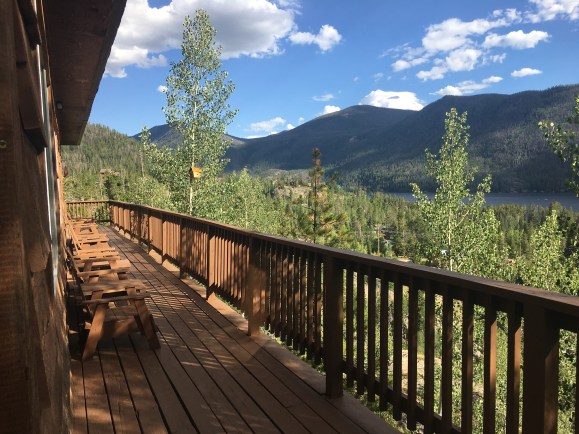
The view from Shadowcliff
I already knew that I loved Shadowcliff Mountain Sanctuary from Kathy and my initial scouting visit one year ago. But I forgot how beautiful it was until I returned this August for our High Altitude Inspiration retreat. Even a (now) Colorado girl like me can’t help but be impressed at the picture perfect view from just about every window (no filters on these pictures!)—the gorgeous city/lake of Grand Lake on one side, the majestic mountains leading into Rocky Mountain National Park on the other. Honestly, I don’t think we could have picked a better location for the Wild American West.
(And for those of you who remember the fox sighting in Breckenridge last year, you will be pleased to know that we had both a bear and a moose (with a baby) sighting!)
Of course, location is only one part of a great retreat—the rest is that elusive beast called “group chemistry.” And boy did we have it. With a short retreat (4 days) there was no room to dawdle, and our group coalesced almost immediately like longtime friends reunited. And consider this is true in more ways than one, as many of our relationships had already been started online and only became flesh and blood in Grand Lake—always so significant in this internet age.
Frankly, we loved it so much that we are doing it again August 19-23, 2020.
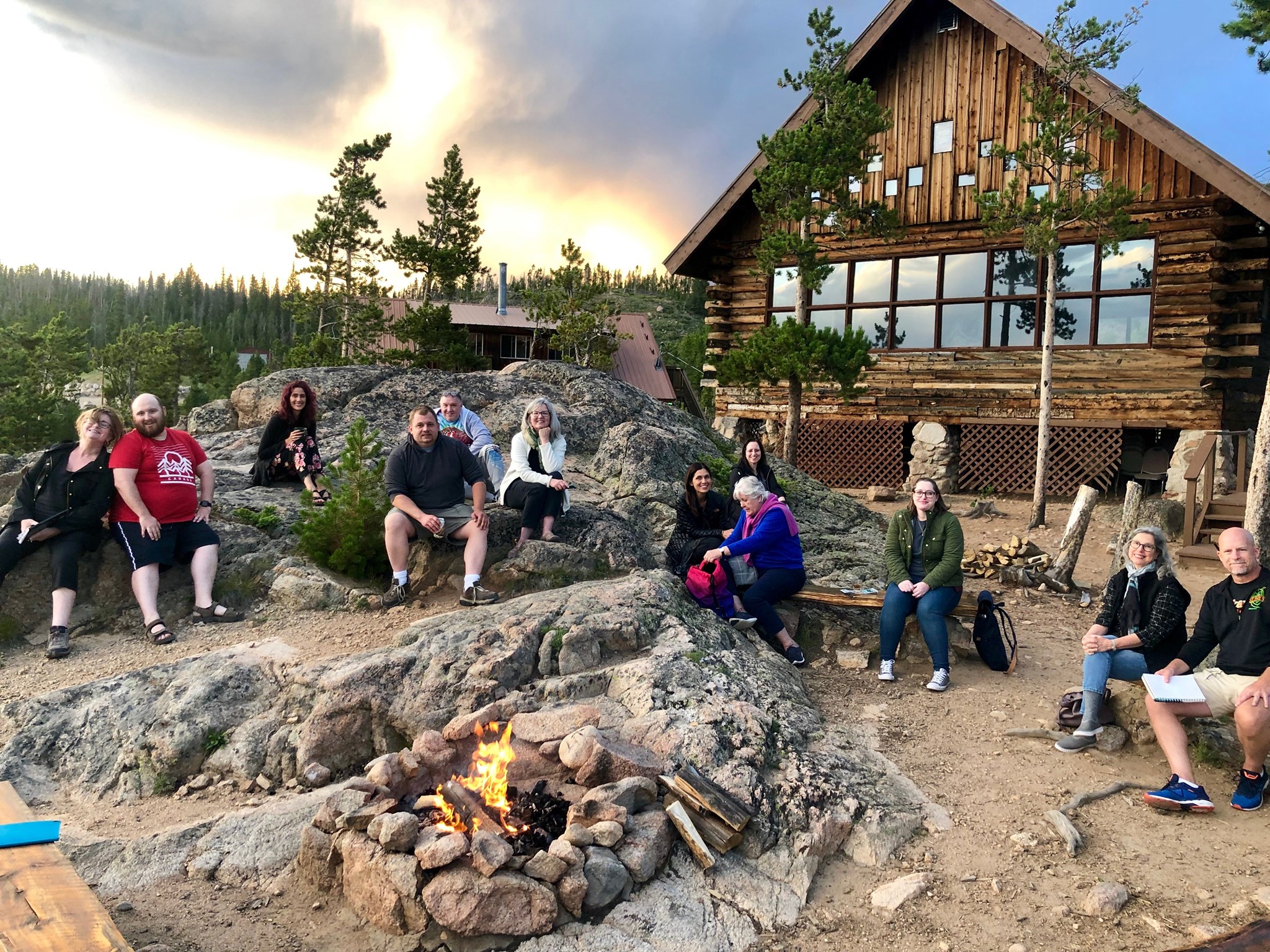
Sunset campfire. Photo by Ryan Stone
So…if you’ve always wanted to see the Great American West and do some serious flash fiction writing at the same time, consider joining us next year! We will be limited to 14 participants, so mark your calendar and stay tuned.
Registration opens soon!
(Can’t wait until August? Join us March 21-27, 2020, in Costa Rica.Registration now open)



 The lovely and talented flash / micro writer, Jayne Martin, will be joining Nancy and me (again!) this summer for our French Connection retreat outside of Bordeaux, France. She also took part in our retreat in Italy last May AND our debut retreat in Breckenridge in 2018! We love Jayne and we love her writing and are so excited about her new collection, Tender Cuts , which comes out November 4th (pre-order from

 Open Your Art Writing Retreats