
Writers fear the word “cliché” almost like it’s catching, a sort of literary herpes. The problem with clichés is that we’re surrounded by them—in speech, on television and movies, on billboards. Clichés are the currency of communication in both speech and the media, so it can be hard to disentangle them from the air we breathe.
Fun fact: The word cliché began with the printing press. In those days, when you wanted to create a page of text, you had to assemble it letter by letter. Words or phrases that were used a lot started to come pre-assembled to save time. These pre-assembled stereotype blocks were called “clichés.”
Sayings and slang are one type of cliché. Think: “On a dark and stormy night” or “happily ever after.” The first guy who said, “It’s raining cats and dogs” must have seemed like a genius. But when you hear that phrase now you don’t picture the dogs, the cats, the sounds of their furry bodies smacking the ground. And that’s the problem. If good writing intends our readers to engage, then clichés encourage us to disengage.
I love this alphabetized list of cliches from the How to Slay a Cliche website:
but here are other types of clichés so insidious we may not even recognize them: descriptions like a “pounding heart”; characters that are all good or all bad like the jock, the cheerleader, or the villain; plots that unfold/resolve in predicable ways, like “the butler did it” or waking from a dream at the end of the story.

Any overworn idea can become a cliché. I once had an editor tell me that all my characters “rolled their eyes”. Not believing her, I did a search through my manuscript and found over 100 instances! Needless to say (cliché!) I have not had a character roll their eyes since.
The sin isn’t in writing clichés, the sin is in not revising them. Each mindless cliché is instead an opportunity to say it in your own, unique, fresh, fantastic way. And that’s the real problem with clichés—they aren’t your original creative wonderful fresh brilliance but a mosaic of everyone else’s rehashed ideas. You don’t want your readers to disengage from your writing because it’s been said a million times (cliché), you want them to be on the edge of their seats (cliché). But if you’re using predictable combinations of words or writing about predictable situations, then your reader is more likely to tune out (cliché) rather than tune in, because he or she has already “been there, done that” (cliché.) See?
So here’s my favorite technique to inoculate yourself against clichés:
Step away from your work for one hour and instead write a story using as many clichés as possible. Cliché phrases, ideas, concepts, idioms, characters, descriptions—really do it up. This will be liberating and fun and ridiculous.
Then after an hour, return to your editing and watch all your own clichés pop right off the page.



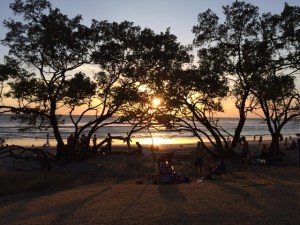 Costa Rica is wild. And although there are resort towns and luxury hotels, Peace Retreat was neither situated in a resort town, nor was it a luxury hotel. And we didn’t want that anyway. We wanted, well, peace. We wanted to retreat somewhere that our group felt like it largely had the place to themselves (except for a handful of yoga students and teachers and some volunteers, we did). We wanted to feel immersed in a peaceful, exotic setting surrounded by nature. We got that. Each day, I woke up just before dawn, to the sound of the birds and the howler monkeys. For the first few days, the wind was powerful. We were surrounded by trees. We spotted iguanas, bright green parrots, horses along the road. A young piglet even came up to greet us on our walk to the beach.
  Definitely a slower pace. Incredibly delicious meals. Fruit so bright and juicy and sweet it was like eating candy. Fresh vegetables and salads, fish, goat-milk dairy, rice, beans, eggs, and freshly baked bread. All of the Peace Retreat staff were so wonderful and kind.
 What a wild adventure! We saw iguanas, parrots, scorpions, hermit crabs. We heard the eerie, hard-to-describe sounds of the howler monkeys, saw a lunar eclipse, and watched the sunset on the ocean almost every evening. We got to take part in a traditional cacao ceremony, walked along the beach looking for a bonfire (didn’t find it!), and met the locals who set up a spontaneous bazaar at the Peace Retreat. We ate wholesome and fresh food 3 times a day and some us us did yoga in the mornings. I slept like a baby in my screened-in cabina, immersed in the sounds of the jungle.

 Open Your Art Writing Retreats