Kathy fish, Writing Prompts & Craft Articles

The Power of Juxtaposition & Creative Alchemy: A Microfiction Prompt

Choreographer Twyla Tharp in her book, The Creative Habit, encourages creatives to keep a journal of the things we see (hear, taste, smell, etc.), especially when they are juxtaposed in interesting ways that draw our attention, be they intentional or accidental. 

It’s tremendously useful to keep a journal of the things that particularly draw your attention in your daily life. Maybe the idea of writing lots and lots of pages of your inner workings every day doesn’t appeal. But you can jot things down. And when you’re stuck, go back and look at them again. I have these odd notes on my phone: snippets of overheard conversation, a phrase from a song, peculiarities of the natural world (or of my neighbors down the street). Lots and lots of photos. Collect images and ideas you’re attracted to. Put them in your phone or folder or spiral notebook, whatever. Just don’t rely on memory!

Doing this, coupled with some daily “down time” (even if only for 15 minutes) will work magic on your creativity. 

It’s about openness and receptivity to, well, a sort of creative alchemy. 
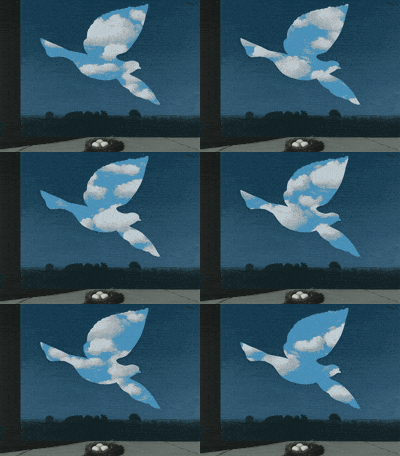
Via: Giphy Flying Rene Magritte GIF by Feliks Tomasz Konczakowski

Juxtaposition is defined as: “the act or an instance of placing two or more things side by side often to compare or contrast or to create an interesting effect.” (Merriam-Webster)

Poets are great at juxtaposition. Haiku writers and mosaicists specialize in it. They jam two or more very different ideas or images together to create new meaning and associations. It’s why we so often get an “ah ha!” experience from reading poetry. Filmmakers and photographers and visual artists of all stripes also make powerful use of juxtaposition.

But flash writers can (and should) make this a part of their toolbox as well. 

In Joy Williams’ collection Ninety-Nine Stories of God, (a book I highly recommend), there’s a flash called “Veracity” that manages, in a scant couple of hundred words, a brilliant juxtaposition of church pews, a birthday bounce house, a dog, and a ’64 Airstream Globetrotter. And every single one of these elements feels necessary and significant. 

My flash, “Foundling” (below) uses a similar jamming together of elements in a very short space:

Foundling

They discovered the baby in the grass, under the snapping cotton sheets. The clothesline spun and creaked, throwing light, then shadow, on his face, his wee head smooth and curved as a doorknob. The woman didn’t bend, only drew her hair from her eyes. He smells like Malt-o-Meal, the little girl said, hoisting him. Support his neck, the woman told her. It’ll snap like a pencil. Christmas Eve, her husband had packed and left for Cincinnati. Now, as raindrops dotted their arms, and the woman’s skirt flicked her calves, he came rushing through the gate, holding a newspaper over his head, calling Margaret! Margaret!


The exercise below will have you bumping together disparate objects / images / ideas in micro form to see where it takes you, what surprises you, what you unearth. You may discover new meaning is created when juxtaposing two disparate objects, ideas, or images. Forcing yourself to do this in a very small space actually serves to ramp up the power of juxtaposition. Very little room is left to “explain” yourself. You must allow what your unconscious delivers to you. The results are often delightful or disturbing, but always surprising.

Microfiction is variously defined by different word limits. For our purposes, let’s say 150 words or fewer. Microfiction often resembles prose poetry. The line between flash and prose poetry is wafer thin at times. But please set aside any need to categorize your work at this juncture. Allow whatever emerges. 

So! Your prompt:

  • I want you to combine two or more disparate elements as compactly as you can, bump them up against each other, in as tiny a story as possible. 
  • Don’t worry in this first draft about “making sense”…your unconscious has a tendency to make its own kind of beauty and sense. It’s what we are wired to do, after all. Find the patterns. And if we can’t find them, we create them.
  • Choose ONE from List A and ONE from List B and get to work!
  • Try to keep to just 150 words or fewer if you can.

List A

tangerine 

ghost

disco ball

Isaac Newton

surgeon

List B

Saturn

Marilyn Monroe

fortune teller

continental drift

funnel cloud

This prompt will be easier if you allow whatever delightful or disturbing weirdness ensues and resist the urge to explain it. Enjoy!
Guest Blog posts, Uncategorized, Writing Prompts & Craft Articles

“Recovering My Creative Self” by Laura Alexander

In this essay, Laura Alexander asks: “How many of us have not chased our dreams because of a flippant comment made by a friend, a teacher, a sibling, a parent?” When Kathy and I first met Laura in Costa Rica, 2019, she was a self-proclaimed “beginning writer at age 60,” and we all fell in love with her bravery and audacity. Here Laura shares some of the pain of loss and reflects on her creative recovery, which she likens to “finding a long-lost friend.” We’re so honored to share in her process and to reunite with her in person in Grand Lake, Colorado this August!

Recovering my Creative Self

by Laura Alexander

For as long as I can remember I have been an avid reader. My teachers would pass around the thin paper Scholastic Book Club flyers and I would pour over them finding at least 8 or 10 books I wanted to order. My Mom would limit my purchases necessitating me to make what I felt at the time were agonizing choices always leaving me wanting more. As my husband shares my love of books our home is wall to wall bookcases filled to the brim.

As strong as my love of books was, my love of writing was what really occupied my soul. Telling stories was my passion until eighth grade when I was asked to read one of my stories to the class. It was a humorous story and I was worried that no one would laugh. But the class did laugh and the further into the story I read the harder they laughed. My teacher, who sat to the right of me at the front of the class, was nearly falling over in her chair she was laughing so hard. What an adrenaline rush! I was filled with excitement and pride over my story writing skills until one of my classmates walked up to me after that class. “Wow,” she said, “I can’t believe how much Mrs. Gregerson was laughing at your story. The whole class was laughing at her. It wasn’t THAT funny.” Then she sauntered away never fully understanding the effect of her words on my future as a writer. From that day on I never shared my stories again. Although I kept a journal from the time I was 16 years old, my short stories stopped and my dream of writing slowly faded away. Over the years I still wrote long personal letters to friends and relatives, occasional poetry and of course my journal. But my artist child had died and it would take 47 years for me to bring her back to life.

At the age of 60, an age when many of us look at our lives and try to figure out what items are still on our bucket list, I discovered flash fiction and began my creative recovery. Using my photography as prompts I started writing 100 word stories. They were quick, they were fun and they fed my creative self-worth like nothing had since writing my stories in grade school. My short 100 word stories turned into longer 500-1500 word stories and then my memoir based on my journal which I am writing for my four sons. For the first time since eighth grade I timidly shared my stories again at the Flash Fiction Workshop in Costa Rica last year. I was lucky enough to be surrounded by fellow writers brimming with creative energy supporting my floundering efforts. I came home inspired and feeling certain this was what I was meant to do with this last third of my life.

We are so impressionable in our younger years, not yet having the wisdom accumulated through life experience. How many of us have not chased our dreams because of a flippant comment made by a friend, a teacher, a sibling, a parent? Trusting my creativity has opened up a whole new aspect of my personality that I had ignored for way too long. I have managed to recover a sense of safety and power with my writing and it feels heartwarming and soothing like finding a long lost friend.

IMG_5330
Laura is a registered nurse, photographer and paddler living with her husband in the San Francisco Bay Area. Many of her flash fiction stories are taken from her poignant experiences as a nurse and from the frequent misadventures of raising her four sons. She is currently working on her memoir in hopes of sharing her life’s journey with her boys and granddaughter.

And check out Laura’s amazing photo gallery of Writing Wild in Costa Rica

Ready to join us in Grand Lake this August? We’d love to have you!


Nancy Stohlman, Writing Prompts & Craft Articles

Not Writing: Why You Might Be Avoiding Your Work

I was inspired to address this issue after I read multiple social media posts, all from writers I admire, all lamenting that they “weren’t writing.”

Not writing is painful. Unfinished work sitting there is painful. You might beat yourself up with a bunch of “shoulds” and berate your lack of discipline. It can make you feel hopeless, drained of energy and questioning if it’s even worth it. No wonder you keep avoiding it!

head-in-sand

But there are usually some very good reasons why you’re avoiding your work. To start with, you’re a better writer now. Just do the math: if you started even one year ago, then you’re a better writer now. And that’s a good thing! That’s the beauty of practice paying off. But it can also feel frustrating when you realize that first story or first draft, the one you labored over, might have made you a better writer but isn’t at your level anymore.

Or you’re in a different emotional place. Often the impetus that drove us to the page resolves or fades; whatever we were grappling with has been settled. Perhaps we’re on the other side of a life change, and the early writing was part of our process, but now we aren’t “feeling it.”

Or you’re overly loyal to your original vision. After all, you’ve probably put in countless hours of work. But sometimes we become too attached to our original vision; sometimes we’ve read and reread our sentences so many times we can’t imagine them any other way. And when we can’t imagine new possibilities for our work, when everything is known and nothing unknown…well, then it’s no wonder we’re not writing.

And, finally, you might be shifting gears. This almost always happens to me after finishing a big project. After a book for instance, I like to consider myself creatively postpartum, recovering from the birth and taking care of the new baby for at least 6-12 months. Anything I try to write in that time will end up sounding exactly like what I was writing before because I haven’t shifted gears, yet.

But it’s discouraging, regardless of the reason, to find yourself fallow, quiet.

So what to do?

1.Give yourself a break. The creative process ebbs and flows, and what goes up must go down…and back up again. Trust the process.

2. Read. I especially like to reread favorite books in these periods. Sink into the familiar and remember why you love words.

3: Remember: creation is ultimately play. Get silly and messy and re-discover what is joyful. Be curious. Be ridiculous. Be shameless. Take a bold risk into new territory and allow yourself to fail. Remember: no one has to know.

Love, Nancy xoxo

*excerpted from Going Short: An Invitation to Flash Fiction coming this summer
Nancy Stohlman, Uncategorized, Writing Prompts & Craft Articles

Revising Flash Fiction: An Inoculation Against Cliches

Writers fear the word “cliché” almost like it’s catching, a sort of literary herpes. The problem with clichés is that we’re surrounded by them—in speech, on television and movies, on billboards.  Clichés are the currency of communication in both speech and the media, so it can be hard to disentangle them from the air we breathe.

Fun fact: The word cliché began with the printing press. In those days, when you wanted to create a page of text, you had to assemble it letter by letter. Words or phrases that were used a lot started to come pre-assembled to save time. These pre-assembled stereotype blocks were called “clichés.”

Sayings and slang are one type of cliché. Think: “On a dark and stormy night” or “happily ever after.” The first guy who said, “It’s raining cats and dogs” must have seemed like a genius. But when you hear that phrase now you don’t picture the dogs, the cats, the sounds of their furry bodies smacking the ground. And that’s the problem. If good writing intends our readers to engage, then clichés encourage us to disengage.

I love this alphabetized list of cliches from the How to Slay a Cliche website:

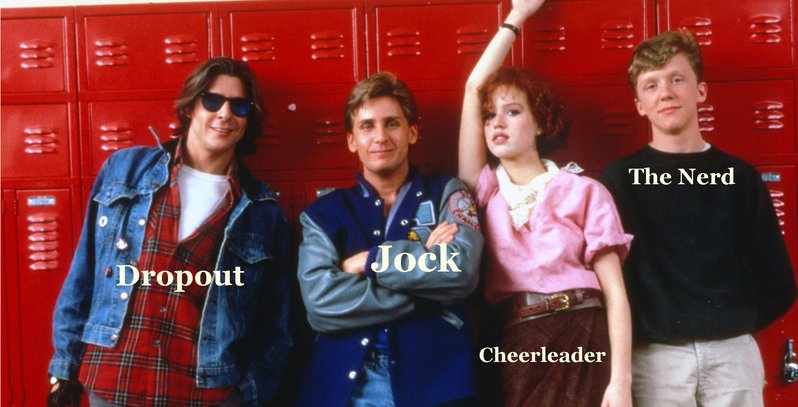
but here are other types of clichés so insidious we may not even recognize them: descriptions like a “pounding heart”; characters that are all good or all bad like the jock, the cheerleader, or the villain; plots that unfold/resolve in predicable ways, like “the butler did it” or waking from a dream at the end of the story.

feature-28

Any overworn idea can become a cliché. I once had an editor tell me that all my characters “rolled their eyes”. Not believing her, I did a search through my manuscript and found over 100 instances! Needless to say (cliché!) I have not had a character roll their eyes since.

The sin isn’t in writing clichés, the sin is in not revising them. Each mindless cliché is instead an opportunity to say it in your own, unique, fresh, fantastic way. And that’s the real problem with clichés—they aren’t your original creative wonderful fresh brilliance but a mosaic of everyone else’s rehashed ideas. You don’t want your readers to disengage from your writing because it’s been said a million times (cliché), you want them to be on the edge of their seats (cliché). But if you’re using predictable combinations of words or writing about predictable situations, then your reader is more likely to tune out (cliché) rather than tune in, because he or she has already “been there, done that” (cliché.) See?

So here’s my favorite technique to inoculate yourself against clichés:

Step away from your work for one hour and instead write a story using as many clichés as possible. Cliché phrases, ideas, concepts, idioms, characters, descriptions—really do it up. This will be liberating and fun and ridiculous.

Then after an hour, return to your editing and watch all your own clichés pop right off the page.

Writing Prompts & Craft Articles

“How is Crafting Microfiction Like Getting a Boat Inside a Bottle?” by Jayne Martin

The lovely and talented flash / micro writer, Jayne Martin, will be joining Nancy and me (again!) this summer for our French Connection retreat outside of Bordeaux, France. She also took part in our retreat in Italy last May AND our debut retreat in Breckenridge in 2018! We love Jayne and we love her writing and are so excited about her new collection, Tender Cuts , which comes out November 4th (pre-order from Barnes & Noble or Amazon.)

Jayne graciously agreed to share her microfiction wisdom in the guest post below. Enjoy!

How is Crafting Microfiction Like Getting a Boat Inside a Bottle?

I have no idea how anyone gets a boat inside a bottle. I’m still trying to figure out how all those people get inside my television. But I do know a bit about writing microfiction. And a touch of mystery is a big part of it.

“It’s what you don’t write that frequently gives what you do write its power” – Toni Morrison

When writing micro, what I describe as stories under 300 words, leaving room for the reader to participate is crucial. To do this, the writer needs to think like a painter, encompassing strong imagery. Our brains are wired to respond emotionally to sensory details.

As a child, I enjoyed lying on my back on the lawn and staring at the clouds as they morphed into angels, butterflies, even sharks. Look! There are his teeth. That’s not a shark, a friend might dispute. That’s a wolf! And who’s to say who was right? Imagination, interpretation – they’re as unique as our DNA.

Tender Cuts (Vine Leaves Press, 2019)

When crafting microfiction, whether it’s a 25-word story or 300 words, the writer needs to engage the reader’s imagination, encourage their interpretation, and give them a fully realized character whose life continues far beyond the constraints of the story. Here is one of the shorter pieces from my new collection of micro, “Tender Cuts.”

Working Girl

Found upright at the curb in the chill of dawn, the single blush-tinted stiletto was the last footprint she would leave on this earth, its mate too quick to step into the car of another faceless stranger. Tiny hands press against a window and wait for her return.

Only 48 words, but what can we gather about this character? Consider the color of the stiletto. It’s not black or red, it’s blush. She still has a softness about her. She was snatched in a way that indicates violence. Likely, she hasn’t yet developed the street instinct to tell the harmless from the harmful. She hasn’t been doing this for long. Consider the “tiny hands” waiting for her return. She’s a mother. Consider the circumstances that could have led her to this state of desperation in order to provide for her child.

I could have written that all out, but doing so would have stripped you of having your own experience of the piece. A micro, even more so than longer literary forms, must leave the reader having had an emotional experience. Otherwise, it risks being just clever. And in writing microfiction, clever is the booby prize.

Jayne Martin lives in Santa Barbara, California, where she rides horses and drinks copious amounts of fine wines, though not at the same time. She is a Pushcart, Best Small Fictions, and Best Microfictions nominee, and a recipient of Vestal Review’s VERA award. Her debut collection of microfiction, “Tender Cuts,” from Vine Leaves Press, is available November 4th. Visit her website at:  www.jaynemartin-writer.com