Blog

Nancy Stohlman, Uncategorized, Writing Prompts & Craft Articles

Flash From Scratch: A Revision Exercise

Sometimes we’ve nitpicked and tinkered our work to death and it still isn’t right. Anaïs Nin says, “Intensive correcting may lead to monotony, to working on dead matter, whereas continuing to write and to write until perfection is achieved through repetition is a way to elude this monotony, to avoid performing an autopsy.”

Once our editing starts to feel like an autopsy, like a Frankenstein of parts stuck together (particularly if we have been working on it for a long time), then the best and quickest way to tackle revision is to write it over, from scratch, without looking.

1960s-business-man-hands-hovering-vintage-images

If that sounds like a huge waste of time, then be grateful you’re writing flash fiction! I give this same advice to all writers, and I have rewritten entire novels from scratch. For real.

Rewriting without looking, while initially infuriating, works wonders, especially if you are stuck. Why? Because all the good stuff from that first draft will make it into the second draft. And all the stuff that was just so-so will improve in the rewrite. Almost magically.

Consider how it works in the visual arts There are often dozens of pre-sketches, studies, and “running starts” at an idea, maybe second, third and fourth attempts at a famous painting. In the Dali museum there are multiple renditions of the melting clocks, for instance; rather than obsessing over one single canvas he made dozens of attempts and filled dozens of canvases until he hit on the famous versions we recognize today.

I remember the first time I had to rewrite without looking. I had a creative writing teacher in college who liked us to compose drafts by hand in class, and then at the end of the class we had to rip out those pages in our notebooks, turn them in, go home and write it over again!

What?!!

large

But because we had no choice, we’d all go home and rewrite our drafts from scratch. Surprisingly, the second version was almost always better. Once we quit resisting the process, we discovered that the rewritten drafts were an organic improvement, a maturation of our original ideas, containing all the best parts of the first draft. And all the stuff that was initially weak would automatically improve in the rewrite.

This process works especially well for flash because you can usually rewrite a draft in one sitting. But the process works for everything—poems, novel chapters, scenes, essays, as I said even a whole book at its most extreme. Jack Kerouac rewrote his book On the Road from scratch three times before he hit on the version we read today. A photographer will shoot the same subject hundreds of times to get just one perfect shot.

And as a bonus, when rewritten all at once, the narrative voice of a story will have a natural cohesion, something that may have been missing in a previous version, particularly if it was composed over a long stretch of time or at various intervals.

So for this reason, I suggest closing that document, opening a new one, and rewrite it from scratch, without looking or reading the first draft.

When Hemingway was asked why he rewrote the ending to A Farewell to Arms 39 times, he said, “To get the words right.”

Uncategorized

On Happiness & Choosing the Creative Path by Chris Bowen

Writer/chef Chris Bowen joined Nancy and me for our first ever flash fiction retreat last summer in Breckenridge. (Read Nancy’s interview with him here.) We’re thrilled he’ll be joining us again in Grand Lake this August. We thank him for sharing his reflections and insights on his creative path since Breckenridge.


It was nearly a year ago I took part in Nancy and Kathy’s inaugural Breckenridge, Colorado writing retreat. It’s been three or more years since Nancy invited me to Denver for the first time, reading for the FBomb reading series then and even further back, it’s likely been ten years or more since I first met her at a reading in NYC.

But life wasn’t always this much fun. Just recently last year, I lost faith. I lost faith in my career as a chef, living and working in an isolated part of Pennsylvania at a college for almost three years, having left my family and anyone I knew two hours away in Cleveland for corporate salary.

Life isn’t always fun, but it damn well better be meaningful.

Moving home to Cleveland then and taking less responsibility with my employer last fall, I was determined to ‘take a step back.’ I had turned to Nancy in Breckenridge even that summer on where my life was going, the fact that I was so unhappy and had been for awhile. I still remember the gray, weather-worn wooden picnic table we sat at in the mountain backyard when I told her that, the kind you look for rusty nails sticking out of before you sit. The heat of the afternoon sun. I had joined the retreat to cook for authors and attendees and aside from sitting in on a couple craft talks between prepping meals, this conversation was the only thing I ever needed.

We talked about happiness, France, doing things by and for yourself. Because anyone only has so little time. Between the talk, it was clear I needed to re-evaluate my life somehow. So, I ended up moving home to find retreat in the only thing strong I really knew I could: my family.

Six months in, I’m a part-time student finishing my bachelor’s degree, but more importantly,  have settled in Denver near those mountain. And writing.

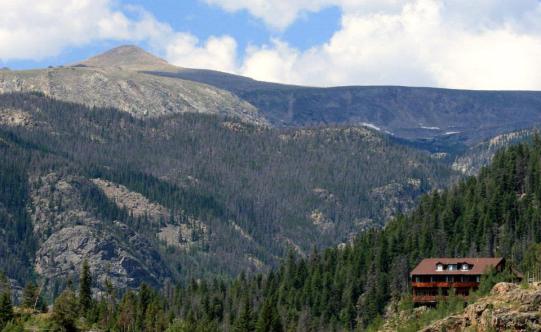
There’s something intimidating about these vistas, how they were formed, how strong they are, how difficult it is to reach them as if ghosts just out of reach.

‘If you can’t inspire yourself, how can you ever expect to inspire others?’ they whisper to me.

I think of the ending to Robert Redford’s movie, ‘A River Runs Through It,’ his voiceover at the end:

“Eventually, all things merge into one and a river runs through it. The river was cut by the world’s great flood and runs over rocks from the basement of time. On some of the rocks are timeless raindrops, under the rocks are the words. And some of the words are theirs. I am haunted by waters.”

I see mountains every day. They remind me of how little I am, how short of time we all are. I don’t know if I’ll live here forever or climb a mountain, but I do know whatever I choose, it will be because I wanted to and because it made me happy.

Christopher Bowen is the author of the chapbook We Were Giants, the novella When I Return to You, I Will Be Unfed, and the non-fiction, Debt. He blogs from Burning River and has traveled throughout the U.S.  

Note: A few spots remain in our August High Altitude Inspiration Retreat in Grand Lake. Consider joining us! We’d love to have you. 

Uncategorized

High Altitude Inspiration: Four Days in the Rocky Mountains with Special Guest…..

 Join us in August 14th – 18th, 2019 for

High Altitude Inspiration:

Four Days in the Clouds in Grand Lake, Colorado

Just Announced: Special Guest Randall Brown!

GL 4

Rise above your normal vantage point. Put your head in the clouds. See what inspiration waits for you when you take the birds-eye view, perched above Grand Lake and nestled in the grandeur of nature and the majestic Rocky Mountains.  

Commune with your fellow writers in a rustic, peaceful setting. Clear your mind. See the big picture. Open yourself to inspired creativity and expansion. Take your writing to new heights with us this August in Colorful Colorado.

Join us for an all-inclusive four-day retreat with two group sessions each day (including craft talks, generative writing exercises, workshopping sessions and one-on-one mentoring as well as plenty of inspired individual writing time), three delicious locally-sourced meals per day, sunset group writes and a final evening literary salon in the stunning chapel overlooking the lake. 

Now with a special BONUS session with renowned flash fiction writer and teacher Randall Brown! 

Randall Brown is the author of the award-winning collection Mad to Live, his essay on (very) short fiction appears in The Rose Metal Press Field Guide to Writing Flash Fiction, and he appears in theBest Small Fictions 2015 & 2017 & 2019The Norton Anthology of Hint Fiction, and The Norton Anthology of Microfiction. He founded and directs FlashFiction.Net and has been published and anthologized widely, both online and in print. Recent published work includes the novella How Long is Forever (2018)the poetry chapbook I Might Never Learn (2018), and the flash fiction collectionThis Is How He Learned to Love (2019).  He is also the founder and managing editor of Matter Press and its Journal of Compressed Creative Arts. He received his MFA from Vermont College.

Hope you can join us!

More info here:

Interviews

Author Jayne Martin on Fear & Self-Sabotage

Nancy and I were so thrilled when the lovely, funny, and talented Jayne Martin, who’d participated in our debut retreat last summer in Breckenridge, signed on again for our upcoming Springtime in Italy Retreat in Casperia. We’d interviewed Jayne before and thought this time we’d do something a little different, so we asked her to share some of her writerly wisdom with us here on the blog. Thanks so much, Jayne!


Let’s Talk About Fear

I haven’t been sleeping well. So last night I put an Advil PM on the bathroom counter to take just before going to bed. And I had a great night’s sleep.

Today I noticed that blue pill still sitting right where I’d put it. Never took the goddamn thing. But I believed I did and so my body acted accordingly. We create our reality according to our beliefs, which is great when those beliefs support our best interests. Not so great when they sabotage us.

Lately, I’ve been in a writing funk. Old demons long thought to be banished have arisen. In my case they’re saying, “You’re not good enough, so we’re going to keep you from embarrassing yourself by giving you a shitload of excuses to not write.”

You might know this particular demon. Or maybe you have one of your very own telling you:

“You can’t achieve your goals because your success will take time away from your family.”

“Other people get all the breaks. The odds are stacked against you, so why even try.”

“Look at all that competition! Damn! There’s not enough success, abundance (fill in the blank) to go around.”

Or the ever-popular, “You’re a complete fraud and you’re going to be found out.” Yeah, I got that one, too.

Recently, I called out another writer on what I saw as her bullshit excuses. I should know better. Not because of the obvious — I had no right to judge her — but because the Universe immediately held up a gigantic mirror and said “Judge not lest ye be judged, bitch.” And so I not only owe that other writer an apology, I owe her a big thank you and probably an expensive bottle of wine because now I’ve been forced to look at my own crippling crap.

I haven’t written a thing I’m proud of in months. The last two workshops I took I expected to choke and what do you know? Choke, I did!

The thing about these sabotaging beliefs is they lurk in the deepest crevices of our minds and then run our lives like little tyrants. We don’t even know they are there until what we don’t want keeps showing up in our lives instead of what we do want. “WHY THE FUCK DOES THIS KEEP HAPPENING TO ME?!”

I’m not a religious person, but a good quote is a good quote:  “As you believe, so it shall be unto you” – Jesus Christ (before we made him a Superstar).

Today I was given three opportunities from the Universe to turn around my fears. The first, as mentioned, was the direction to look at my own sabotaging beliefs before I judged others. The second was an invitation from Kathy and Nancy to write this post to which my immediate reaction was, “Oh shit! What am I going to write about?” The third was the loving outreach from a dear writer friend encouraging me to take an upcoming workshop.

Our demons are constantly testing our vigilance. So, I’m going to take that workshop with expectations of only fun and joy, and that is the experience I’m going to create.

Jayne Martin is a 2017 Pushcart nominee, 2016 winner of Vestal Review’s VERA award, and a 2018 Best Small Fictions nominee. Her work has appeared in Literary Orphans, Spelk, Crack the Spine, Midwestern Gothic, MoonPark Review, Blink-Ink, Cabinet of Heed, Connotation Press and Hippocampus among others. She lives in California where she drinks copious amounts of fine wine and rides horses, though not at the same time. Find her on Twitter @Jayne_Martin.

NOTE: Our Springtime in Italy Retreat is now full, but openings remain for High Altitude Inspiration: Four Days in the Clouds in Grand Lake, Colorado (this August) and we’ve just opened registrations for our return to Costa Rica for Writing Wild in 2020! Join us!


Kathy fish

“Just Read” (from an essay originally published in Lascaux Review)

I’m often asked my advice to writers. Mostly I say, just read.

Read Flannery O’Connor. Read Joy Williams. Read William Maxwell.  (Please read  William  Maxwell.)

Read about the universe. Read about neuroanatomy. Read “On the Origin of Species.”

Read “Nine Stories.” Read Tolstoy. Read Carson McCullers. Read Edward P. Jones. Read Willa Cather. Read Yasunari Kawabata. Study atlases and maps. Read E.B. White. Read fairy tales.

Remember that “fresh new voices” can come from people over forty. Find those writers and read them.

Read Shakespeare. Read Amy Hempel and Lydia Davis. Compare. At least once a week, read a book published by a small press. Read, read, read poetry.

Find a book on Entomology. Learn the names of all the insects that inhabit your backyard. (Or make up names for them.) Read Freud. Read graphic novels. Read prose poetry and flash fiction. Study the dictionary.

Read a book about a place you never been to from a writer whose name you can’t pronounce.

Read naked. But not in public.

Find and read a newspaper from the day you were born. Or any old newspaper. Learn another language, then read a novel or poetry in that language.

Read “One Fish, Two Fish, Red Fish, Blue Fish” out loud with no children present.

Read philosophy.

Buy a thick notebook and write “Sentences I Love” on the cover. Fill it up and buy another one.

Read collections of short stories and flash fiction.

Read the history of the town you grew up in.

Read Jane Austen and Edith Wharton and the Bronte sisters. Read Katherine Mansfield and Shirley Jackson and Kõbõ Abe. Read Grace Paley. Read Chimamanda Ngozi Adichie. Read long into the night until the characters walk around in your dreams. Read “The Dead” at least one winter afternoon a year.

Or don’t read any of these and just read whatever the hell you want. Whatever books strike your fancy at any moment in time. The only mistake you can make as a writer is not reading.

But should your mother or your aunt or your grandmother or grandfather want to tell you their stories, close whatever book you’re reading and listen.

~Kathy